May 26, 2026
Reflection 1:
Practicum:
- What you learned that you did not expect to?
Sometimes the most important thing is getting students to come and stay in class.
- Best Part?
The best part was connecting with and building relationships with students.
- Worst Part?
The worst part is trying to get students caught up on course content after they’ve missed. It feels like running to stand still and it never ends.
- Humorous Part?
When one of my students drew my teacher mentor as a magical girl and me as the villain taking over his classroom.
- A discipline?
A bullying incident that involved a group of boys and a girl that ended up being escalated to admin.
Activity 1:
- Past – What did you know about Indigenous worldviews and ways of knowing a being coming into the program? What have you learned over the duration of the program and in your practicum placements?
Coming into the program, I was aware of initiatives like Orange Shirt Day and I had some brief exposure to the First Peoples Principles of Learning. During my engineering education, there weren’t any connections to Indigenous worldviews, only Land Acknowledgements on the first day of class. After starting the B.Ed. I feel like my world has tilted on its axis as I grapple with my shifting paradigm. At the start of the program we learned about thigs like Dr. Brokenleg’s Circle of Courage, FPPL, Land Based Learning, and many other Indigenous pedagogies to incorporate into our teaching philosophies. During my practicum placements, I learned that Indigenous pedagogy is simply good teaching practice. Experiential learning, land-based inquiry, personal connections, storytelling, reflection, community involvement are just a few things I have learned during the B.Ed. and my teaching experience so far that I actively incorporate into my practice. I also try to bring in holistic and system based thinking, something that is integral in physics but is a direct connection to Indigenous worldviews that we can use alongside our Western step-wise thinking.
- Present – How do you value Indigenous worldviews and ways of knowing and being currently in your teaching practice? What specific examples can you detail to show what that looks like in your teaching and/or in the learning experiences you create for students?
For the introduction to our Work, Energy, and Power unit in Physics, we had a lesson on indigenous, holistic systems thinking versus the step-by-step western scientific view. We connected the example of the work and energy of a river and how the Secwepemc and Syilx peoples both used the energy and power of rivers without needing complex math to quantify it. We then went on to discuss why it is important in innovation to think holistically like this, using the example, “Are paper plates or reusable plastic plates more sustainable?”. We talked about the whole life cycle of each plate rather than focussing on a specific step such as, “paper plates are single use and you can reuse a plastic plate multiple times.” The aim of this lesson was for students to adopt the holistic view of systems (the Indigenous pedagogical view) as well as the step-by-step view of systems (the western scientific) as both are extremely valuable to us.
During our introduction to forces lesson, I did a presentation on Indigenous worldviews of forces and engineering and the importance of observation, relationships, and balance. We also talked about how this unit specifically looks at the balance of objects in systems using math, and how important it is to understand how this math fits into our environment. After the lesson, we compared the two knowledge systems (western scientific vs. Indigenous) and found the commonalities are essential to scientific discovery and innovation: evidence based, refined over time, and adapted to the environment.
- Future – What plans do you have to continue your journey toward meeting standard 9? What kinds of activities could you engage in to learn more?
I’m learning that my strict positivist worldview that relies heavily on evidence and observation to acquire truth and knowledge is limiting and actually quite dangerous. I am now looking to develop a deeper understanding of Standard 9 by challenging my worldview to value Indigenous epistemology, ontology, and axiology the same way I would as my personal philosophies. It is hard for me to connect with learning from symbolism, spirituality, visions, and dreams when those are not things I can explicitly observe and measure as I would while following the scientific method. These forms of knowledge, truth, and reality, are what I am working to understand.
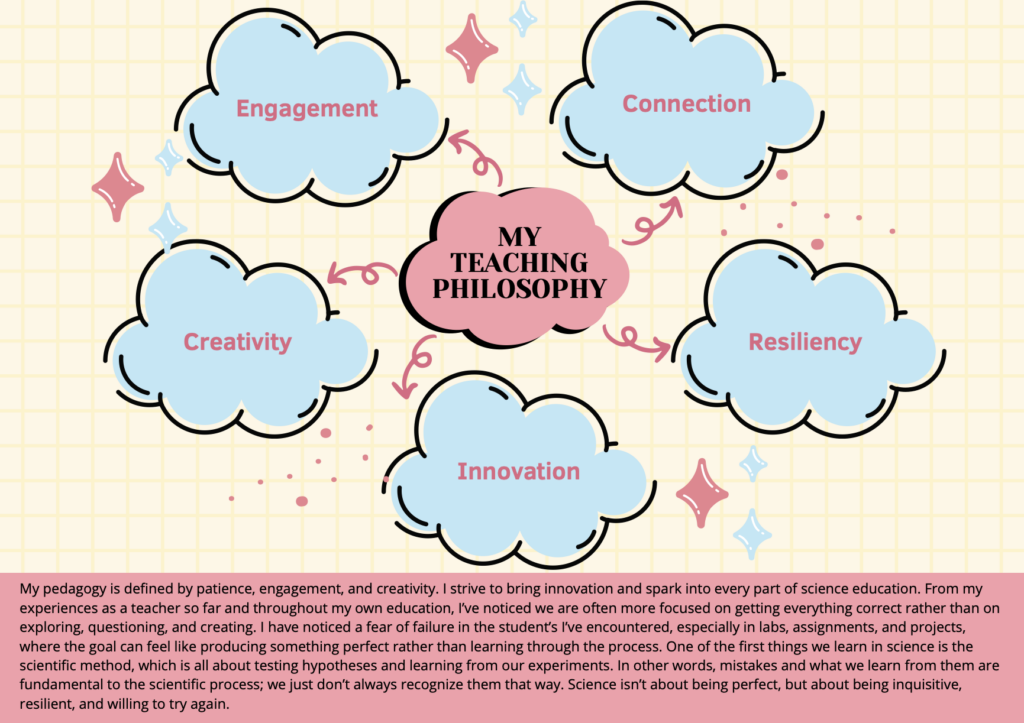
Teaching Pedagogy Art and Artist Statement
May 27, 2026
Reflection 2:
- What adjectives would others use to describe your presence in the classroom? Why?
- Encouraging: meet students where they’re at and set individualized goals
- Engaging: create interesting multimodal lessons that relate to students interests
- Personable: Get to know the students and their interests outside of the school setting
Mock interview questions:
- What is your teaching philosophy? Give an example of how you enact it in your teaching.
My pedagogy is defined by patience, engagement, and creativity. In my future classroom, you will see active participation, project-based learning, and experiential opportunities designed to empower and prioritize student success. My practice is rooted in building the strong connections that make learning exciting and relevant. For example, when my Physics 11 students were following the Artemis II Mission, I adapted our lessons so we could analyze the physics behind the flight path around the moon. This led to an ethical, Socratic debate where students took on the roles of different stakeholders who would be interested in owning the Moon while using physics to argue for their side. Ultimately, this allowed disengaged students to see physics as a real-world tool rather than just a set of equations. I have also worked with students to overcome their academic anxieties through evidence-informed assessment alternatives and scaffolded learning tools. These experiences have shown me that when students feel seen and supported, they feel empowered to take ownership of their own learning.
- What adjectives would others use to describe your presence in the classroom? Why?
Answered above
- Tell me about a time when students responded positively to one of your Indigenously inspired activities. What was the activity? What did students take away in their learning?
For the introduction to our Work, Energy, and Power unit in Physics, we had a lesson on indigenous, holistic systems thinking versus the step-by-step western scientific view. We connected the example of the work and energy of a river and how the Secwepemc and Syilx peoples both used the energy and power of rivers without needing complex math to quantify it. We then went on to discuss why it is important in innovation to think holistically like this, using the example, “Are paper plates or reusable plastic plates more sustainable?”. We talked about the whole life cycle of each plate rather than focussing on a specific step such as, “paper plates are single use and you can reuse a plastic plate multiple times.” The aim of this lesson was for students to adopt the holistic view of systems (the Indigenous pedagogical view) as well as the step-by-step view of systems (the western scientific) as both are extremely valuable to us.
- Tell me about a time when you overcame a difficult challenge in your teaching practice. What was the challenge? How did you overcome it?
A bullying incident involving a group of boys and a girl in my grade 11 class. The boys had created a group chat and were sending hurtful messages and pictures back and forth about the girl. One of the boys told her about it and she reported it to me. We escalated it to the school’s administration. This was challenging for me because I had to remain impartial and treat the boys fairly and equitably in the class still even though I was extremely disappointed in them. Since the problem was in the administrations hands, I was told to not address it in class at all, but this was difficult for me because I saw how deeply it affected the girl who was bullied. I learned a lot about how to show up as an educator for all in that moment.
Can also talk about report cards here and how I had to write all four classes report cards on my own!
- Tell me about a time when someone gave you constructive but challenging feedback about your teaching practice, and how you handled that.
During the early days of my 4-week teaching practicum, I was told by my teacher mentor that the structure of the unit I designed was too rigid and too content heavy so I should go back and rethink the first few days. This was the first time I designed a lesson I was really disappointed and frustrated because I designed it so well according to the curriculum and competency areas. Now that I’ve had a lot more experience with this, I can see that my TM was trying to tell me that my class wouldn’t be able to handle 40 minutes of notes and two activities every single day, and she was right. I learned through this that flexibility and understanding your students abilities is very important while planning, and that you can’t only look at the curriculum while planning.
- How do you manage students with challenging behaviour in the classroom?
In Math 9 during my first teaching day, I asked the students to teach me about their class rules and expectations. We filled in the blanks where I thought they needed some structure, and we also came up with repercussions for breaking the rules. I am following these rules very strictly now because I would rather have rules and structure in place now, then ease off the gas as we get into a routine. An example of enforcing these rules is telling students to stay off their phones while in a work-block (when they aren’t allowed to be on their phones), telling off-task students they have one more strike before I ask them to move seats, and taking our Battleship review game away from students who were misbehaving and giving them a worksheet instead.
- How do you acknowledge Indigenous worldviews in your teaching?
For the introduction to our Work, Energy, and Power unit in Physics, we had a lesson on indigenous, holistic systems thinking versus the step-by-step western scientific view. We connected the example of the work and energy of a river and how the Secwepemc and Syilx peoples both used the energy and power of rivers without needing complex math to quantify it. We then went on to discuss why it is important in innovation to think holistically like this, using the example, “ Are paper plates or reusable plastic plates more sustainable?”. We talked about the whole life cycle of each plate rather than focussing on a specific step such as, “paper plates are single use and you can reuse a plastic plate multiple times.” The aim of this lesson was for students to adopt the holistic view of systems (the Indigenous pedagogical view) as well as the step-by-step view of systems (the western scientific) as both are extremely valuable to us.
During our introduction to forces lesson, I did a presentation on Indigenous worldviews of forces and engineering and the importance of observation, relationships, and balance. We also talked about how this unit specifically looks at the balance of objects in systems using math, and how important it is to understand how this math fits into our environment. After the lesson, we compared the two knowledge systems (western scientific vs. Indigenous) and found the commonalities are essential to scientific discovery and innovation: evidence based, refined over time, and adapted to the environment.
In every lesson I try to connect to at least two First Peoples Principles of Learning. Lately we have been focussing on, “Learning is holistic, reflexive, reflective, experiential, and relational (focused on connectedness, on reciprocal relationships, and a sense of place)”, and “Learning is embedded in memory, history, and story”. Basing our lessons in experience and context leads to better learning, and providing lots of anecdotes and stories makes our content more relational.
- How do you cultivate positive relationships with your students and create a sense of class community?
Getting to know my students outside of school, what their interests are, and not always relating things to our course content. Sometimes it is just nice to talk about the mountain biking race they were in yesterday without trying to tie that into Physics 11. I also try to cultivate positive relationships with my students by learning their names as soon as I can. I think it is very important as a teacher to know each student individually, and the first and most important step of that is learning their names, especially if they are international students with names that are difficult for me to pronounce.
I also think that making myself seem human who is capable of failure or doing something wrong builds a strong sense of class community. It is not just me up at the front of the class teaching, but I am constantly learning along with them and they have some authority in their own learning. Acknowledging when I make mistakes, or when something leads to confusion on worksheets/quizzes and taking accountability. An example of this is when a question on our “Force” of Nature worksheet was worded weirdly leading to a lot of confusion, so I decided to take it off the assignment.
- Give evidence through an example which shows how you design learning environments which address diversity and support all learners in a class.
I learned that one of my students in math 9 really struggles with all things with numbers and even told me she was diagnosed with dyscalculia. After investigating I saw she didn’t have an IEP for this so I couldn’t make any specific accommodations for her for this. I asked her the best way for her to learn, and she said pictures and diagrams really help and looking at the equations we’ve been doing are really confusing. Because I thought this was a really good insight and every student would benefit from this, I decided to make a summary sheet for them to refer to while studying and completing their practice questions. This was very image and diagram heavy with some blanks students have to fill in so it was also collaborative.
One thing that I am very proud of is a resource I developed for students to use a study tool but also to give students some *hidden* graphic organization. I made a title page for our dynamics unit where students can decorate the front and make notes on the back with structured sections on key vocabulary, essential equations, steps for solving equations, and free-body diagram essentials. I wanted to give students this resource to organize their thoughts and their binders! We learned about resources like this to help students with ADHD, but I thought it would be a good for all students to have. I am giving them a bonus 1% mark in this unit if they turn it in at the end before their unit test and hopefully it encourages everyone to study all of the content instead of just practicing solving equations!
- How do you keep your students engaged and motivated in your lessons?
I try to tie whatever we are doing into a real-life context so students can see the “why” of what we are doing. This was reflected really well in the “Force” of Nature activity where I showed some videos of animals and people being airlifted from flood areas in Chilliwack (local context) so they could see how they were working on something that is used in real life and not a made up scenario. The students were all on task and working diligently in their groups during this activity because they were invested in saving as many baby animals they could.
Sharing stories of how I have applied what we are learning about to the real world (engineering applications, work experience…) examples: When we were doing the “force” of nature activity I talked about when I worked at the naval base in Esquimalt during the big floods and landslides on the Coquihalla highway I got to see these rescue helicopters in action, and how the engineers had to make sure the cables and forces acting on the helicopters were safe for their rescue operations (which was exactly what we were doing in class when saving the baby animals from a flooded area!)
- What do you do to maintain your own professional development? What areas would you select for your personal growth?
Engaging in professional learning reading and watching informative videos about teaching style and pedagogy
Connecting with other teachers at my school (who are not my Teacher Mentors) for their input and views on certain lessons.
From reading the article “The Real Deal on Classroom Management for New Teachers” by Craig Simmons, my biggest takeaway was to have consistent routines and build positive relationships with students to have the biggest chance of success when managing a classroom.
The article “Why Students Give you the Blank Stare and What to Do About It” by Blake Harvard really emphasized the importance of activating prior knowledge and chunking new content into manageable amounts to avoid cognitive overload in or students.
- What does collaboration mean to you? How do you engage in collaboration to improve your teaching practice and relatedly, student learning?
Valuing all members of the learning team (teacher, student, CEA’s, admin, families). Collaboration means that everyone has a voice and everyone is valued as part of the students’ learning community. I engage in collaboration to improve my teaching practice by constantly asking for constructive feedback on my lessons and how I can improve. An example of this is when I invited a VP into my class to observe my lesson and then we had a debrief afterwards on how I could improve.
- What are some assessment methods you use to check for understanding as you are teaching?
Observation and conversations with students during my lessons are a very informal way I check for understanding while teaching. I also sometimes use a thumbs up or down to quickly check attitudes and understanding on the lesson. While making my assessments for the physics classes, I struggled with the caliber of the tests and how hard I should make them. The quizzes were quite hard, as they are meant to be used for a check in for students (and myself). But the unit tests I decided to test on what they know, rather than what they don’t know (if that makes sense). I didn’t want to throw a lot of questions that they’ve never seen before, rather, I wanted to give them questions that directly tested the learning outcomes of our class, then add in some harder, critical thinking questions at the end to make some distinction between extending students. We also started peer marking some assignments in my Math 9 classes. Before we start, I ask students to remind me of what good feedback looks like. After we are done, I get them to write “one thing they did well” and “one thing they could strengthen” on their classmates’ assignment.
- Which extra-curricular activities, clubs, or sports are you willing to be involved in if you are offered a position?
If I am offered a position, I would love to be involved with the school’s volleyball team if there is the opportunity. I was involved with school and club volleyball throughout my secondary education, and it gave me such a strong sense of community while I was a student that I would love to cultivate that same sense at the school I am at.
I would also really love to be involved with an engineering/robotics club, or a fine arts club! These are two of my interests (outside of athletics) that I am super passionate about.
- What would you do if there was a situation unfolding in your classroom that compromised student safety?
I would clear the area and remove the other students from the class to isolate the situation in the classroom and prevent harm to the students. Next, I would involve/call a school administrator immediately to bring them into the situation. I would ask another adult to supervise my students while I diffuse the unsafe situation in the way I am able. If it is above my capabilities, I would turn responsibility to the administrator and then turn my attention back to my other students.
Activity 2:
– Teach something in two minutes or less: drawing a wolf
June 2, 2026
Reflection 3: This is a 3-2-1 reflection. Following the mock interview activity, reflect about the following:
3 – Three things you did well during the mock interviewing
- Using the STAR format and bringing meaningful examples that relate to the questions I was being asked.
- Made eye contact with my interviewer
- Did not use “um” too much.
2 – Two things you need to work on during the mock interviewing
- Not fidgeting, I feel like I was constantly moving around.
- Not going on a long-winded story. I think with some of my answers I gave a lot of context to the story I was telling that was not necessary to get to the point of what I was trying to say.
1 – One question you still have about interviewing
- I have a written portion of my interview after I conclude the actual spoken interview. What could this be?
Activity 3, Reflection 4: Resume TOP 10: What are 10 things I could change about my resume? I spent many years on this already so it was hard to think of 10!
- Incorporate things that don’t relate to teaching/education
- A portion on skills
- Adding all of my certifications (safety and ethics certificates)
- Changing the layout so it is easier to read
- Emphasizing my practicum experience more changing the layout of things
Exit Activity 4: 1 minute video about yourself
Point form notes of what I said.
- I am originally from Kamloops and graduated from Norkam.
- I graduated from UVIC with my Biomedical Engineering degree, am completing my B.Ed. at TRU, and looking forward to completing my M.Ed. at TRU starting this fall.
- My interests are:
- Hiking with my dog Sage
- Reading (mostly fantasy novels)
- Rewatching my favourite movies (Studio Ghibli and Pride and Prejudice!)
- Formula 1
- Volleyball
- Art
- Trivia Night
June 3, 2026
Reflection 5:
The Professional Standards for BC Educators #7 states that: Educators engage in professional learning. The focus of this reflection is to consider how you are meeting BC Professional Standard 7. In particular for this reflection, you are considering your professional learning, profession growth, and professional needs. Some questions to consider in your reflection:
- What “individual professional needs” have you identified?
- The induvial professional needs I have identified are:
- Wellness and time management. While I was on practicum, I sacrificed almost every weekend and evening to lesson planning and marking. This is an area I really need to develop as it is unsustainable to maintain over the course of my career.
- Varied assessment tools. I have noticed that I use a lot of the same assessment tools to assess students’ learning. I want to incorporate more conversation assessment into my Physics classes but I do not know how to do so as of right now.
- What teaching areas of interest or areas of professional growth would you like to work in the coming year?
- I am starting my M.Ed. in the fall this year, so I would like to focus my courses in the program on curriculum development, content, and learning modes if that is possible!
- I am passionate about accessible and meaningful learning tools, so any professional development opportunities that relate to that would be the most interesting for me.
- Our research group is also expanding to reflect the growth in this project. I will be building off my pilot project to explore and evaluate microbiology teaching practices using objective analysis of observations and surveys with the graphic novel and presentation in the TRU M.Ed. program while completing my thesis. My thesis committee includes Dr. Cheeptham, and now Dr. Alana Hoare, and Dr. Gloria Ramirez. We also have new community partners including, Morgan Whitehouse with SD#73, Dr. Óscar Enrique Gómez Rodríguez from Universidad Nacional de Colombia, and Dr. Jen Tam, a pediatric infectious disease physician at BC Children’s Hospital and a Clinical Assistant Professor at UBC. This research team will collaborate to develop a holistic and informative microbiology literacy project that utilizes the information found in this pilot project in the near future. In relation to my professional growth, I would like to develop my communication and interpersonal skills while collaborating in such a large and highly qualified group of individuals.
- What kinds of professional learning opportunities are you interested in?
- I would be interested in conferences or workshops to develop my skills. I do appreciate reading articles, but I find the best learning happens for me when I listen to an expert and apply it
- Have you already engaged in professional development over and above the BEd program? What was it? How did it inform your teaching? Did it have an impact on student learning?
- My current research project explores the effectiveness of graphic novels as a tool for science education, specifically in teaching microbiology concepts to school-aged students. Graphic novels are a rapidly expanding medium among youth, praised for their capacity to integrate concise text with compelling visual narratives. Many students hold misconceptions about microorganisms, often perceiving them as harmful due to limited coverage in the BC curriculum and portrayal in the media. By integrating creative teaching methods into science education, this study aims to inform evidence-based strategies for improving early science literacy, supporting antimicrobial stewardship, and inspiring future interest in STEM and One Health perspectives. This approach can be incorporated into classrooms for all ages and disciplines to improve engagement and promote student-centred learning. I have presented my findings on this research at the 2026 TRU Teaching Practices Colloquium, the 2026 TRU Undergraduate Research Conference, the 2026 TRU Science Undergraduate Poster Exhibition of Research, and the 2026 Art in Science public art exhibition hosted by the UBC Okanagan Biology Graduate Student Society
Activity: 5: Group Traits
| Group Members: | Same | Unique |
| Rita, Selina, Lauren, Tasfia, Corey, Pam, Erin, Sondra | Right Handed | Sondra – twin |
| Corrected Vision | Erin – from a Territory | |
| All have hair longer than chin length | Pam – born in the 60’s | |
| All travelled outside of North America | Corey – run 42 km | |
| All drive a car | Tasfia – 2 brothers | |
| Can all ride a bike | Rita – does Chinese calligraphy | |
| All over the age of 24 | Selina – Scuba diving licence | |
| All like to read books | Lauren – Grew up in Kamloops |
June 8, 2026
Reflection 7: post-KTTA meeting
My biggest takeaway from the KTTA presentation is that we are going to be under public scrutiny, forever. Even during the summers, even during breaks, on holidays, we have to adhere to the professional standards for teachers. We have to be hyper vigilant in our actions and words because everything is held up to the magnifying glass.
250 words about yourself
Hi, I’m Lauren!
Originally from Kamloops, I am a high school science teacher who loves bringing curiosity, creativity, and enthusiasm into the classroom. My educational journey began at the University of Victoria, where I graduated with a Bachelor of Engineering in Biomedical Engineering, before returning home to earn my Bachelor of Education at Thompson Rivers University.
By blending scientific inquiry with artistic expression, I encourage my students to ask big questions, think critically, and embrace mistakes as a natural part of learning. My goal is to help them develop a lifelong love of science and discovery. Alongside teaching, I am involved in research focused on microbiology learning tools for school-aged children, constantly exploring new ways to make science more accessible, engaging, and meaningful for young learners.
When I’m not in the classroom or diving into research, there’s a good chance you’ll find me out hiking with my golden retriever, Sage (proudly named after our gorgeous, local sagebrush). Indoors, I love curling up with a good fantasy novel, experimenting with new recipes in the kitchen, or working on an art project. And on those perfect, low-key evenings, you’ll probably find me rewatching my favorite Studio Ghibli movies with a big bowl of popcorn for dinner.
June 9, 2026
Reflection 8: 4-Directions Secondary School
My key takeaway from today’s presentation from Jordan Smith is that fulfilling student’s social and emotional needs is vital to their success academically. Providing students a space to succeed, feel comfortable, and have their needs met, comes before any academic content they need to fulfill. This is even more important for Indigenous students who feel the burdens from the historic colonial practices that are still imbedded within our system. The Four Directions Secondary School emphasizes every aspect of Indigenous education that we have learned about in the B.Ed. I wish our curricular framework allowed for the same flexibility, but I think a problem we would run into is the post-secondary institutions that still require the colonial-structured grades and education.
June 10, 2026
Reflection 9: Jamie Reflection
My key takeaway from the presentation from Jamie was how many resources are available at TRU that I still have yet to discover. I have made many websites for my courses and other endeavours, but I haven’t accessed this TRUBOX website resource yet, and I didn’t even know it existed. I really liked how she walked us through the privacy settings we can change on the website, because I probably wouldn’t have been able to figure them out on my own.
Reflection 10: Why did you choose this profession?
My interest in becoming a teacher has come from my experiences working with students in many different settings. From volunteering in a Physics 11 classroom, where I was helping to answer questions and guide students through laboratories, to creating and delivering lessons for a computer science club for girls and gender non-conforming youth, I have had a wide variety of opportunities to connect with kids. My time in these environments has shown me that patience is the most important quality in a teacher. This is a value I learned from working with high school students where I helped them achieve their learning goals based on their individual needs.
Integrity is also something I hope to instill in the students I teach. I believe my role as an educator is not to tell students what to think, but to show them an approach to inquiry-based learning so they can critically think about the world around them.
Working with students in art programs, in science classrooms, and in computer science clubs, showed me the value of being present and caring for students’ learning. In each of these settings, there has been one common denominator: teaching is not only about the dissemination of knowledge but also igniting excitement and passion in each student.
June 15, 2026
Reflection 10: Pooja Reflection
One thing I learned from the Pooja’s Make a Future presentation was how many resources there are available to us during the application process. There are YouTube videos available for free, created by Make a Future, on how to write a resume and best practices for interviewing. This is just one example of a helpful resource that is always available to us and very informative. Since we already had this same presentation at the beginning of the program, it was quite nice to have it again while we are actually applying to jobs.
Activity 6: Collaboration and teamwork are central to a healthy school culture. Can you describe a time when you worked closely with colleagues to support student learning or create/improve a school initiative? What was your role, and what was the outcome? During my practicum at Mount Boucherie, I worked alongside my teacher mentor and a C.E.A. in my physics class to create a “calculation guide” for my students. I noticed that many of my students were having issues breaking down word problems into the steps I detailed for them, so I wanted to make a resource they could use and apply to every question they encountered in our Dynamics unit. This resource ended up being so successful that I made a similar calculation guide/template in my Work/Energy/Power unit. I relied on the expertise of my teacher mentor to develop the content for the guide, and turned to my C.E.A for implementation and structural guidance.
June 16, 2026
Reflection 11: Please provide an example of a time when you had to use problem-solving and judgement skills to navigate a conflict with a supervisor, co-worker, or parent. Please include your approach to managing the conflict, what steps you took, what the outcome was, and what you would consider doing differently in future situations.
The conflict that comes to mind was in my Math 9 class during my long practicum. There was a student in that class with very avoidance behaviour who was very capable in class but reluctant to engage with any of the course content. One day at the end of class, I asked him to clean up a mess he made with a few of his friends. His friends stayed, but he ran out of the class yelling, “I can’t do it, I’m disabled.” As a result of his actions, he was taken out of his next class and brought to the vice principal’s office. While he was at the office, I sent an email home to his mom under the guidance of my teacher mentor. His mom asked to schedule a phone call with me. My teacher mentor was busy and wasn’t available to be on the call with me, so I took it by myself.
Through some other experiences in my life, I knew how to handle the call. I used clear language and filled her in on the situation free of any anger or emotion, just stating the events that happened. I also made sure to emphasize her son’s strengths in my class and how I want him to learn from this experience to become the best version of himself. She agreed completely and let me know that he had been acting out in other classes as well and was hoping that this incident would lead him down a better path. Overall, it was a really constructive conversation and the mom and I discussed the best ways to ensure her son’s success in my class. I think the biggest takeaway from this incident is that it is best to approach parents as being a part of their child’s learning team, and to bridge difficult behaviour issues with emphasizing their students’ strengths.
Activity 7: Tell me about a time you incorporated First Peoples Principles of Learning into a class assignment or activity?
In every lesson I try to connect to at least two First Peoples Principles of Learning. Lately we have been focussing on, “Learning is holistic, reflexive, reflective, experiential, and relational (focused on connectedness, on reciprocal relationships, and a sense of place)”, and “Learning is embedded in memory, history, and story”. Basing our lessons in experience and context leads to better learning, and providing lots of anecdotes and stories makes our content more relational. Two examples are detailed below:
During our introduction to forces lesson, I did a presentation on Indigenous worldviews of forces and engineering and the importance of observation, relationships, and balance. We also talked about how this unit specifically looks at the balance of objects in systems using math, and how important it is to understand how this math fits into our environment. After the lesson, we compared the two knowledge systems (western scientific vs. Indigenous) and found the commonalities are essential to scientific discovery and innovation: evidence based, refined over time, and adapted to the environment.
I want to make physics not just about solving systems using math, I want them to connect it to real world issues. One Physics 11 class we spent analyzing the physics behind the Artemis II launch, and then we had a Socratic, ethical debate where each group of students adopted the role of a stakeholder wanting to own the moon. This was so successful and the students enjoyed it so much, I decided to scrap my lesson with the Pre-AP Physics Class and do it with them as well. It was the most fun I think I’ve ever had, and the kids told me they felt the same way.
June 17, 2026
Activity 8: Carousel Discussion Activity
Topic: Technology in Schools
Group Members: Tasfia, Rita, Selina, Lauren
What other ideas or questions related to the topic do you have?
• How does increased technological use impact student mental health and cognitive functioning?
• How do you reconcile parental, peer, and community expectations around technology with classroom expectations?
What are the trends, challenges, and issues related to the topic?
• Social media bans for youth under 16 (UK, Canada, Australia, etc.)
• Increased use of AI by teachers and students
• No training on social media safety for youth
• Increased presence and use of cell phones in the classroom
How might these trends, challenges, and issues impact you as a new teacher?
• Good that they are banning social media for youth
• Technology can make some learning more accessible (e.g., homework help apps, classroom activities)
• Challenging to regulate AI and cell phone use
• Challenging to regulate technology safety
How will you navigate these trends, challenges, and issues?
• Clear and reinforced classroom expectations
• Facilitating discussions on safe use of technology