My “Why’s”
I strive to bring innovation and spark into every part of science education. From my experiences as a teacher so far and throughout my own education, I’ve noticed we are often more focused on getting everything correct rather than on exploring, questioning, and creating. I have noticed a fear of failure in the student’s I’ve encountered, especially in labs, assignments, and projects, where the goal can feel like producing something perfect rather than learning through the process. One of the first things we learn in science is the scientific method, which is all about testing hypotheses and learning from our experiments. In other words, mistakes and what we learn from them are fundamental to the scientific process; we just don’t always recognize them that way. Science isn’t about being perfect, but about being inquisitive, resilient, and willing to try again.
To bring this sense of resiliency and passion into my classroom, I try to make science engaging and relevant. I encourage every student to explore their unique interests, and to keep an open mind when learning about new ones. One day, I noticed that many of my students were following the Artemis II Mission, so in one of my Physics 11 classes, we spent the whole day learning about the physics behind the flight path around the moon. This led to an ethical, Socratic debate where students took on the roles of different stakeholders who would be interested in owning the Moon, while using physics to argue for their side. After this specific class, I had a student approach me who had never participated in class before, but who was very vocal during the debate, say that he didn’t know physics could be so fun and that he thought it was just about using equations the whole time. I am glad he got to see a real application of what we were learning, and that science extends so far beyond numbers and significant figures. This debate led to a connection with this student that has lasted ever since, and his performance in the class reflects his new passion for space diplomacy.
It is the connections with students that confirmed I am where I am meant to be. In the early days of my qualifying practicum, I quickly forged a connection with a student who was struggling with a fear of failure. This manifested in a form of test anxiety that stopped her from finishing any test she started. Throughout my practicum, we spent many lunch hours trying to find a method of assessment that worked for her. Although we did find a test-taking method that worked for her after trying a few evidence informed alternatives, the best part of working with her was our connection. If she had a bad soccer game, needed advice, or wanted to show me a funny picture of her dog, she stopped by the class to talk to me. It was because of this connection that she felt empowered to tell me when she was experiencing a bad anxiety attack and communicated her needs instead of shutting down like she would before. Seeing her success in the class and her renewed authenticity towards her own learning, is the reason why I want to be teacher.
Philosophy Visual Art and Statement
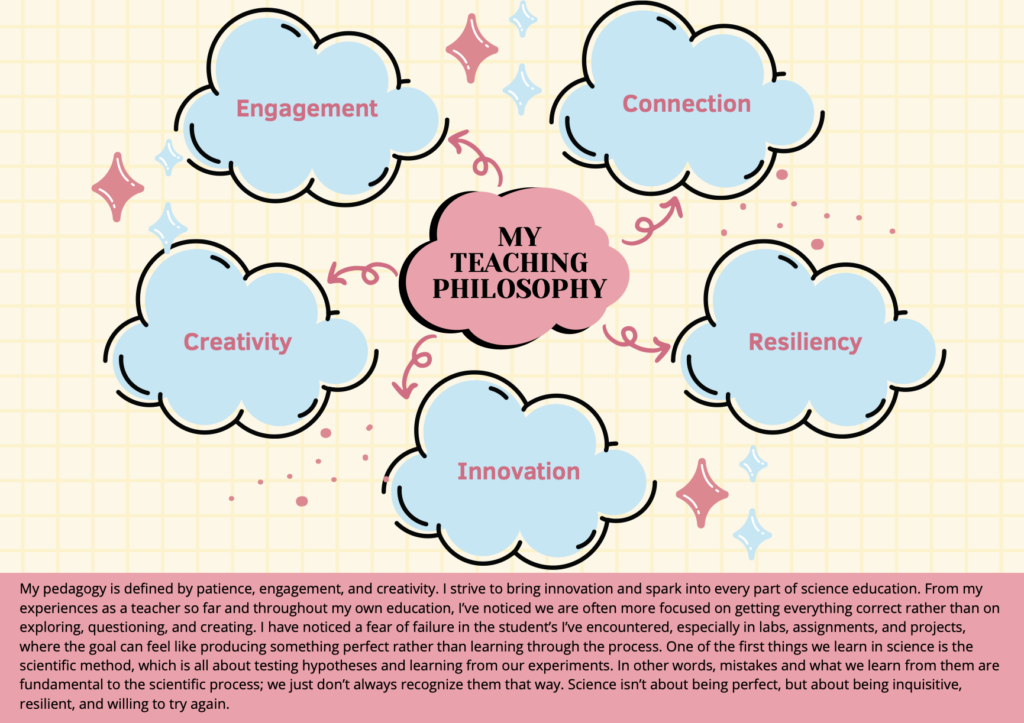
My Teaching Philosophy and Commitment to Standard #9
My teaching philosophy is rooted in engagement. If you were to peek in on one of my classes in the future, you would see some form of active participation, project-based learning, individual work time, or experiential learning that students can choose from to demonstrate their learning. You may also see students learning outside from the land, engaging with members of the community, and connecting to stories or other knowledge systems. This is a great way to bring UDL into the classroom since these strategies are a form of inclusion. My experience as a student also informed my teaching philosophy. I needed the chance to explore the learning method that worked best for me in a given situation. In the past, I realized I needed experiential and project-based learning to understand physics concepts. But I didn’t always need experiential learning. Sometimes in other classes I really needed to work by myself and review equations in a textbook, or sometimes I needed to watch videos and listen to my teacher explain concepts. I now understand that when students can make decisions that honour their own ways of knowing while also connecting to others, their community, and the land, that is when the most authentic learning happens. I want to ease that struggle for my students by giving them choice from the start, in essence, multimodal learning.
I was struck by the parallels between trauma-informed practice and the characteristics of an inclusive classroom. Trauma-informed practice is embracing the individual, and a characteristic of an inclusive classroom is that everyone is welcome in class discussions. Similarly, both emphasize giving students the time and space to think, getting students to connect personally to subjects to engage, and being flexible as an educator. These practices closely align with Indigenous circle processes, where there is a shared space of respect, listening, and reflection where each learner contributes to the wealth of knowledge of the class. We need to come from a place of empathy to truly connect with our students. Taking the time to be a trauma-informed educator and creating an inclusive classroom go hand in hand, and I hope over time these will become natural to me.
I refer to Dr. Brokenleg’s Circle of Courage as a guide for my teaching philosophy, and I hope to bring it into lessons for my students to use as a guide for their learning. The Circle of Courage emphasizes the importance of connection and purpose in students’ learning, which is represented in the “belonging, mastery, independence, and generosity” sections of the circle. When done with meaningful purpose, I will connect Indigenous processes, products, content, and contexts to my lessons while integrating the First Peoples Principles of Learning to connect my teaching style with traditional teaching and learning styles. I will facilitate holistic, reflective, experiential, and relational learning where students will have the opportunity to learn from the land, the community, their family, and themselves in a meaningful way.
Simply, active thinking leads to engagement, engagement leads to inclusion, and inclusion is my goal as an educator. Engagement is not only cognitive, but it is also emotional, relational, and spiritual. True inclusion will happen when students can see themselves as part of a bigger picture that celebrates their strengths and includes their classmates, their community, and the land they live on. I hope to create true inclusion and interaction instead of physical integration. I want students to engage with me and each other about topics they’re excited about. I want to facilitate their learning and get excited with them over new discoveries about the world and themselves. I want to create a space where students feel safe and accepted for who they are. That will only come from dedicating myself to my teaching philosophy and incorporating all of these elements in a purposeful way. UDL can seem like a simple concept when you peek into my class working in the way that suits them best, but it goes much deeper and is rooted in inclusion, trauma informed practice, and meaningful purpose.
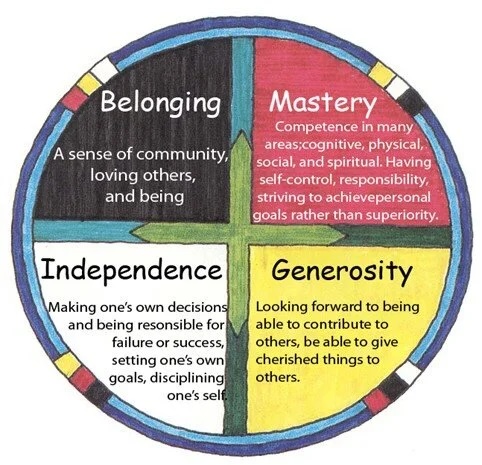
Image Source: https://www.buildingbrains.ca/blog/circle-of-courage